


What ERP Data Models Work Best for High-Volume Trading Operations

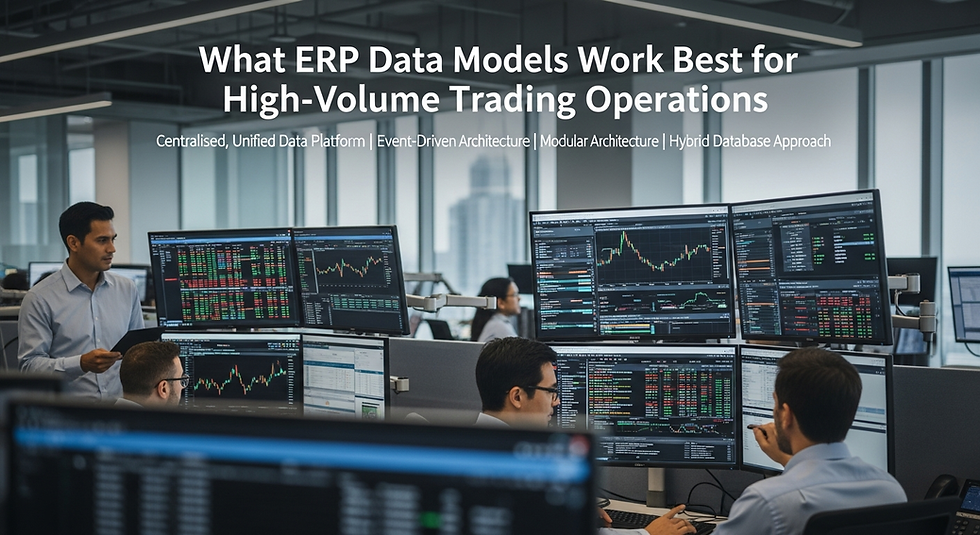
A trading business has various aspects to manage, including billing, inventory, procurement, customer relationships, and logistics. Hence, it can be overwhelming to keep a tap on and handle all these operations manually. Even handling the operations with fragmented tools can lead to scattered data, errors, and confusion. However, incorporating ERP software for a trading company in India is an innovative solution that keeps things streamlined effortlessly. ERP data models are designed around a modular event-driven architecture and centralised data platforms that support real-time processing.
If you are looking to integrate ERP into your trading operations, then here is a list of ERP data models that can work best.
Centralised, unified data platform
A modern ERP software for trading businesses in India is like the backbone of an organisation. It consolidates data from various functions, such as logistics, sales, and finance, on a single platform. Thus, it eliminates data silos and ensures accuracy and consistency across the organisation.
Event-driven architecture
Event-driven architecture (EDA) in ERP systems is a design in which components communicate by reacting to events such as inventory changes, sales, or payments, rather than via rigid requests. The EDA benefits high-volume trading, where every trade order and market update is treated as an event.
Modular architecture
This type of ERP data model only enables businesses to implement the necessary modules. It offers businesses flexibility and scalability to adapt and grow. The modular architecture of ERP provides integration capabilities and enables organisations to expand their ERP infrastructure easily as they grow or change.
Hybrid database approach
The hybrid database approach includes relational databases, which are used for core transactional data and ledgers due to their strict ACID (atomicity, consistency, isolation, durability) properties. Moreover, there is in-memory data stress that's used for real-time analytics and caching book orders. And some time-series databases are essential for storing and analysing high-frequency market data at high speed.
The best data model prioritises accuracy, scalability, and speed through a flexible, integrated architecture that supports real-time data flow and advanced analytics. Choose an ERP for trading companies that best fits your business size, supports multi-location control, is customisable, and integrates easily with ZipERP. They offer professional implementation and after-sales support for your trading company's ERP.


Comments